
Product Description
| Model NO. | SPE |
| 1)Material | SS304/SS316 |
| 2)Size | 1/8″-4″ |
| 3)Connection Ends | Thread |
| 4)Suitable medium | Water, gas, air and some corrosive liquid |
| 5)Temperature Range | -20-300 degree C |
| 6)Sealing | PTFE,RPTFE |
| 7)Shipment | BY Sea,By air By express according to customers’ Requirements |
| 8)Deliverytime | usual 25 days around and can negotiate as per order qty |
| 9)Shipping port | ZheJiang |
| 10)Term of Payment | 30%TT deposit,70% against copy of B/L |
| 11)MOQ | 100 PCS/size |
| Capacity to produce | 100000PCS/MONTH |
FAQ
Q: Why would I choose you ?
A: Our company has dedicated ourselves to research and develop stainless steel ball valves more than 20 years, such as pipe fittings, valves and flanges. Advanced manafacturing aquipment, perfect inspection methods would assure the qulity of products and superb service. Sovereignty for exporting and importing and over 20 -year export experience would assure our cooperation smooth.
Q:May I have free samples before ordering ?
A : Yes, our company is very pleased to send you free samples for quality test.
Q:What about production time ?
A : Sample order- 4-7 days of out of stock , or deliver at once.
Massive order- 5-20 days after getting deposit, depend on exact order.
Q: Do your company has the export licence ?
A : Yes, we have Soverei ghty for export and import.
Q:Which trade terms can I choose ?
A: EXW, FOB, CIF. As for other trade terms, we can negotiate accordingly.
Q: How about payment terms your company accept?
A: For small testing orders, we accept western union and T/T.
For massive orders, we accept T/T and L/C
Q: Are you a factory or trading company ?
A: We are a company specialized in manufacturing valves and fittings for more than 20 years. And we have obtained the verification of compliance for ball valves from ECM and ISO9001 certificate of manufacturing and processing of valves and fittings.
Q:Which are the main market of your products?
A:We are pleased to cooperation with the company from all over the world.And our valves and fittings have been exported in North America and South America and Asia,Europe and Middle East.
Q: Do you have a minimum quantity of the products?
A: No, we will build bussiness with you only 1 piece. We believe this cooperation will long-term relationship for our high quality , competitive price and superb after-sale service.
Q:Can you print logo on the valves ?
A: Yes, we can totally produce products according to your private preferences.
Q:How can I check your factory situation when it is unconvenient to China ?
A: We have photos and videos on website and ,which shows the every steps of production.
Q:How can you guarantee the quality of products ?
A:First of all,we have the advanced control device to manufacture products accurately.
Then, our quality inspectors will test product 1 by 1 to make sure every valve and fitting we sell is qualified.
Q:How long is the quality guarantee period?
A:We supply 6-12 months for quality guarantee accorig to customer using frequence.
Q:How do you pack?
A:Plastic bags-paper box-ccrtons-plywood case
/* March 10, 2571 17:59:20 */!function(){function s(e,r){var a,o={};try{e&&e.split(“,”).forEach(function(e,t){e&&(a=e.match(/(.*?):(.*)$/))&&1

How do you Properly Install and Secure a Half Coupling to Ensure a Leak-Free Connection?
Properly installing and securing a half coupling is essential to ensure a leak-free and reliable connection in piping and plumbing systems. Follow these steps to achieve a secure joint:
- Cut and Prepare the Pipe: Start by cutting the larger pipe to the desired length, ensuring a clean and even edge. Use a deburring tool or file to remove any sharp edges or burrs that could interfere with the coupling’s sealing surface.
- Check Threads and Fit: For threaded half couplings, inspect the internal threads of the coupling and the external threads of the pipe. Make sure they are clean and free from debris or damage. Ensure that the threads match and fit properly, as any misalignment can lead to leaks.
- Apply Thread Sealant: Before attaching the half coupling, apply a suitable thread sealant, such as Teflon tape or pipe dope, to the male threads of the pipe. The sealant helps prevent leaks by filling any gaps or imperfections in the threads.
- Attach the Half Coupling: Thread the half coupling onto the pipe’s male threads carefully. Use a wrench to ensure a snug fit, but avoid over-tightening, as it may damage the threads or cause stress on the joint.
- For Socket Weld or Butt Weld Couplings: For socket weld half couplings, insert the smaller pipe into the coupling’s socket and align it properly. For butt weld half couplings, weld the coupling to the larger pipe’s end with proper welding techniques and safety measures. Follow industry standards for welding procedures and ensure a smooth and consistent weld for a leak-free joint.
- Check for Leaks: After installation, perform a leak test to ensure the joint is secure. Apply a pressure test or use a suitable leak-detection method to verify the connection’s integrity. If any leaks are detected, disassemble the joint, inspect for issues, and reassemble following the proper steps.
- Consider Thermal Expansion: In applications with temperature variations, consider the thermal expansion and contraction of the pipes. Provide sufficient flexibility in the system to accommodate these changes and prevent stress on the joints, which could lead to leaks over time.
- Follow Manufacturer’s Instructions: Always follow the manufacturer’s instructions and recommendations for the specific type and material of the half coupling being used. Different couplings may have unique installation requirements and torque specifications.
Proper installation and securing of a half coupling are crucial for maintaining the integrity of the piping or plumbing system and ensuring a leak-free connection. Following these steps and adhering to industry standards will help achieve a reliable and durable joint.
Are there Special Half Couplings Designed for Specific Types of Pipes (e.g., Stainless Steel, PVC)?
Yes, there are special half couplings designed to be compatible with specific types of pipes, such as stainless steel, PVC, and other materials. The choice of half coupling material should be based on the properties of the pipe and the requirements of the application. Here are some examples of special half couplings designed for specific types of pipes:
- Stainless Steel Half Couplings: These couplings are specifically designed to be used with stainless steel pipes. Stainless steel is known for its corrosion resistance and is commonly used in applications where the conveyed fluid or gas may be corrosive or require high hygiene standards. Stainless steel half couplings provide a reliable and durable connection in such environments, making them suitable for industries like food processing, pharmaceuticals, chemical processing, and marine applications.
- PVC Half Couplings: PVC pipes are widely used for water supply, drainage, and irrigation systems due to their lightweight, corrosion resistance, and affordability. Special half couplings for PVC pipes are typically made of PVC material or other compatible plastics. These couplings ensure a secure and leak-free connection in PVC pipe systems, especially in residential and agricultural applications.
- CPVC Half Couplings: CPVC (Chlorinated Polyvinyl Chloride) pipes are used in applications where higher temperature and pressure resistance are required compared to standard PVC pipes. CPVC half couplings are designed to be compatible with CPVC pipes, providing a reliable joint for hot water supply, industrial piping, and other high-temperature applications.
- Copper Half Couplings: Copper pipes are commonly used for water supply lines and in refrigeration systems. Half couplings made from copper or brass are suitable for connecting copper pipes, ensuring a tight and durable connection in residential and commercial plumbing systems.
- Galvanized Steel Half Couplings: Galvanized steel pipes are coated with a layer of zinc to enhance their corrosion resistance. Half couplings made from galvanized steel are used with galvanized pipes in outdoor applications or in areas prone to corrosion, such as in sprinkler systems and outdoor water distribution.
- Alloy Steel Half Couplings: In high-pressure and high-temperature applications, where the properties of carbon steel are not sufficient, alloy steel half couplings are used. These couplings are designed to handle the demanding conditions of industries such as oil and gas, petrochemicals, and power generation.
It is essential to select the right half coupling material that matches the properties and requirements of the specific type of pipe in the system. Using a compatible half coupling ensures a reliable and leak-free connection, reduces the risk of corrosion or degradation, and contributes to the overall efficiency and longevity of the piping system.
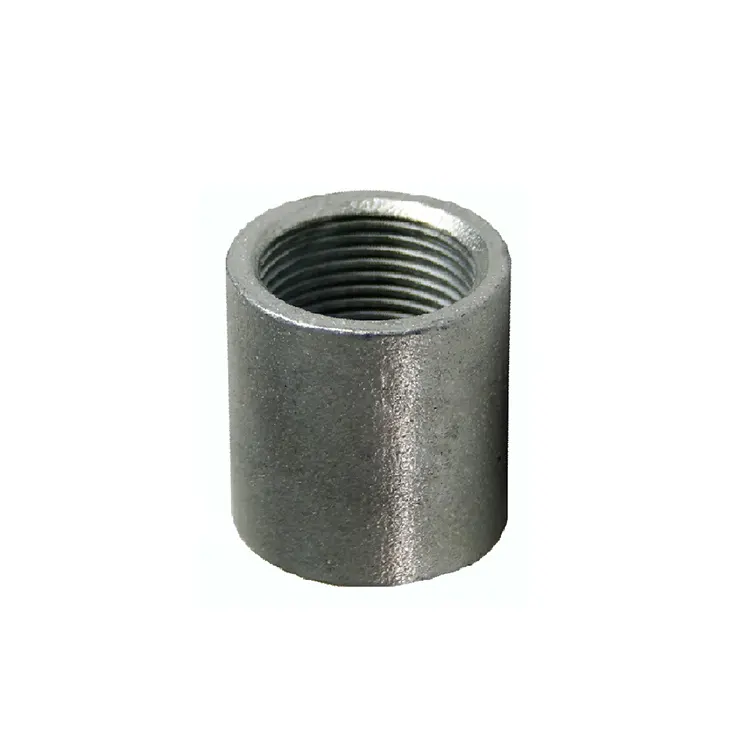
What are the Standard Sizes and Dimensions Available for Half Couplings?
Half couplings, as pipe fittings used in piping and plumbing systems, are available in various standard sizes and dimensions to accommodate different pipe sizes and applications. The sizes and dimensions of half couplings depend on the pipe’s nominal diameter and the specifications set by industry standards organizations. Some common standard sizes and dimensions for half couplings are as follows:
- Thread Sizes: Half couplings come with different thread sizes to match the corresponding pipe threads. Common thread sizes for half couplings include 1/8″, 1/4″, 3/8″, 1/2″, 3/4″, 1″, 1-1/4″, 1-1/2″, 2″, 2-1/2″, 3″, 4″, 5″, 6″, and larger.
- Length: The length of a half coupling refers to the distance from one end to the other. It is typically a few inches, depending on the pipe size and application requirements. Lengths for half couplings can range from around 1 inch to 12 inches or more.
- Outer Diameter (OD): The outer diameter of a half coupling refers to the measurement across the widest point of the coupling’s external surface. It corresponds to the pipe’s outer diameter it is intended to connect to. Common OD sizes for half couplings include 1.05″, 1.32″, 1.66″, 1.90″, 2.38″, 2.88″, 3.50″, 4.50″, 5.56″, 6.63″, 8.63″, and others.
- Materials: Half couplings are available in various materials, as mentioned in the previous answer. The material selection depends on factors such as the type of fluid being transported, the temperature, the pressure, and the corrosion resistance requirements.
It is essential to refer to industry standards, such as ANSI (American National Standards Institute), ASME (American Society of Mechanical Engineers), or ASTM (American Society for Testing and Materials), to ensure that the half couplings meet the specific dimensional and material requirements of the application.
When selecting a half coupling, it is crucial to consider the following factors:
- Pipe Size Compatibility: Ensure that the half coupling’s thread size matches the pipe’s thread size to create a secure and leak-proof connection.
- Application Requirements: Consider the operating conditions, including pressure, temperature, and the nature of the fluid being transported, to choose the appropriate material and dimensions for the half coupling.
- Standards Compliance: Select half couplings that meet industry standards to ensure safety and compatibility with other components in the system.
In summary, half couplings are available in various standard sizes and dimensions, with different thread sizes and materials to accommodate diverse pipe sizes and applications. Proper selection based on the specific requirements of the piping or plumbing system is essential for ensuring a reliable and efficient connection between pipes.


editor by CX 2024-01-12