
Product Description
| LAMAT PIPING – Wrought Steel Fittings | ||
| Name | Socket/Coupling,Reducing Socket/Coupling,Elbow,Street Elbow,Tee,Bushing,Union,Bend,Cap,Plug,Cross | |
| Close Nipple,Short Nipple,Shoulder nipple,Long Nipple,Running Nipple,Barrel Nipple | ||
| Technology | Wrought Steel,Casting,Forging,Welded or Seamless pipe | |
| Thickness | SCH40, SCH80, SCH160; CLASS A, CLASS B, CLASS C | |
| Pressure | 150LBS,300LBS | |
| Surface Finish | Steam Black,Electrical Zinc Plated,Cold Galvanised,Hot Dipped Galvanised… | |
| Design Standard | American Standard | ASTM A733 |
| European Standard | EN15711 | |
| British Standard | BS EN15711,BS1387,BS21,BS1740 | |
| Germany Standard | DIN2982,DIN2440 | |
| ISO Standard | ISO 49,IS1879 | |
| Thread Standard | ASME B.1.20.1 / EN15716 / DIN2999 / ISO7-1 / ISO228 / IS554 / BS EN15716 / BS 21.173 | |
| Material Standard | ASTM A106/A53 GR.B,API 5L GR.B,ASTM A105 | |
| Size | 1/2″-8″ // DN15-DN200 | |
| Packages | Plywood Cases or Plywood Pallets or Boxes | |
| Application | Petrochemical & Gas Industry,Chemical,Machinery,Electric Power,Ship Building,Construction Water Works,Valve Industry,etc. | |
| Advantages | High Quality + Ready Stock + Faster Delivery + Customized | |
| Brand | LMP | |
| Certificate | ISO9001,API,CE,UL/FM | |
Factory & Workshop Show
Production Process Show
Company Profile
WHO WE ARE
Lamat Piping established in 2002s,is 1 of China’s leading piping manufacturing and exporting suppliers,specialized in qualified steel flanges, butt weld pipe fittings and malleable cast iron fittings for clients from over 60 countries and regions worldwide.
Lamat Piping is the single and independent exporting department of NPCC(National Piping Construction Cooperation),who is a group company with 5 factories located in ZheJiang and ZheJiang , where the regions have very long histories in manufacturing Steel & Iron products dating back to 1990s. CHINAMFG Piping(NPCC) aims to combine and intergrade some leading and high quality industries to become a modern and international piping supplier in the new century. Now we have more than 30 producing and machining lines with over 1000 normal workers and 80 technical employees. Our factories covers over 300,000 square meters,and has an annual output of 500,000Tons.
WHAT WE PRODUCE
Lamat Piping(NPCC) is producing flanges from 1/2” to 144” – Standards including ASTM B16.5, EN1092-1, BS4504, BS10, SANS1123, DIN, JIS, UNI, GOST, KS, AS, etc. Products including Plate Flanges FF/RF, Slip On Flanges FF/RF, Blind Flanges FF/RF, Welding Neck Flanges, Screwed Flange, Socketed Flanges, Lap Joint Flanges,Backing Rings Flanges,etc. Pressures includes 150LBS to 2500LBS in ASTM B16.5,PN6(T6/3/4/8) to PN100(T100/3/4/8) in EN1092-1/BS4504/BS10, T600/3/4/8 to T4000/3/4/8 in SANS1123.
Lamat Piping(NPCC) is producing butt weld fittings from 1/2” to 144” – Standards including ASTM B16.9, JIS B2311, EN15713, DIN, GOST…etc. Products including 45/90/180 Degree Short/Long Radius Elbow,Equal/Reducing Tee,Cross,Concentric/Eccentric Reducer,End Cap.
Lamat Piping(NPCC) is also producing malleable cast iron fittings from 1/2” to 6” – Standards ASME B16.3, ASME B16.14,BS EN15712,BS1256,DIN2950, BNR6943, ISO49,etc. Products including Elbow,Bend,Tee,Socket,Nipple,Bushing,Union,Cap,Plug,Back Nut.
WHAT WE SOURCE
With 30+ years constant efforts and experience,now CHINAMFG Piping(NPCC) has become our customers’ expert manufacturer and supplier for a very wide range of piping products.And today CHINAMFG Piping is not only supplying Flanges,BW fittings & Malleable Iron Fittings produced by ourselves,but also sourcing and exporting various Pipe Fittings & Valves s from China’s leading industries,including Cast Iron Valves, Ductile Iron Pipe Fitting, Stainless Steel 1,2,3PC Ball Valve, Stainless Steel 150LBS NPT/BSP Fittings, Wrought Steel Fittings,Grooved Fittings,Forged Steel Fittings,HDPE Pipes Fittings Valves,PVC Pipes Fittings Valves, Brass Valves Fittings,etc.
WHAT WE PROMISE
”BETTER QUALITY, BETTER SERVICES” is our promise to all of our customers and ”CREATE VALUE FOR CUSTOMERS” is our ultimate goal. CHINAMFG Piping promises that we’ll continue to put quality in the first place;besides,we will not lose our fixed-focus on the service aspect of our business,which has been,and will continue to be the foundation of our success and our future growth.
WHAT YOU CHOOSE
If you’d like to trust CHINAMFG Piping,Lamat people will do the best to be worthy of your trust!
Products Details
Packaging & Shipping
Samples Room Show
Canton Fair & Exhibitions
FAQ
| Q0: Are you a factory or trading company? | ||
| A: We are a factory mainly producing pipe fittings & flanges. We also have cooperated factories to supply other piping products. | ||
| Q1: How do your Control the Quality? | ||
| A: We have QA & QC department who will follow up all the producing process to make sure we’re supplying correctly. | ||
| Q2: What Machines are you using for Manufacturing and Machining? | ||
| A: We have Forging/Stamping Machine,CNC Machine,Hole-Drilling Machine,Sandblasting Machine. All producing is in our factory except Galvanization. | ||
| Q3: Can we get Samples for Testing? | ||
| A: Yes,sapmles are supplied free of charge. | ||
| Q4: Can you accept OEM & marking our LOGO? | ||
| A: Yes,no problem if you can provide Authorization. | ||
| Q5: Can you offer Drawings & Datasheets? | ||
| A: Yes,Drawings & Datasheets will be sent for your confirmation before Bulk Production. | ||
| Q6: Can you supply MTC with EN15714 3.1/3.2 Certificate? | ||
| A: Yes,MTC will be provided after production is finished. | ||
| Q7: Can we visit your factory to inspect the goods before delivery? | ||
| A: Yes sure. Welcome to our factory,and we also accept Third Party Inspection like SGS,TUV,BV,etc. | ||
| Q8: Can you combine goods from our other suppliers to ship together? | ||
| A: Yes,we’d like to assist you to ship together to save your time and money. | ||
| Q9: How long is your Delivery Time? | ||
| A: It depends on quantity and products. It can be delivered in 1 week if we have Ready-Stock; if not,the General Production Time is 25 – 50 Days. | ||
| Q10: What’s your Payment Terms? | ||
| A: Currently we’re working with our clients under T/T,L/C,O/A,Western Union,etc. |
/* March 10, 2571 17:59:20 */!function(){function s(e,r){var a,o={};try{e&&e.split(“,”).forEach(function(e,t){e&&(a=e.match(/(.*?):(.*)$/))&&1
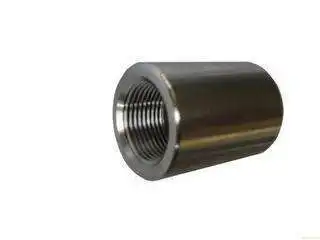
Are there Specific Safety Considerations when Using Half Couplings in High-Pressure Systems?
Yes, there are specific safety considerations to keep in mind when using half couplings in high-pressure systems. High-pressure applications pose unique challenges, and it is crucial to follow safety protocols to prevent potential hazards and ensure the integrity of the piping or plumbing system. Here are the key safety considerations:
- Pressure Ratings: Ensure that the half couplings used in high-pressure systems are rated for the intended pressure levels. Half couplings have specific pressure ratings based on their design and material. Exceeding these ratings can lead to coupling failure and catastrophic leaks.
- Material Selection: Choose half couplings made from suitable materials capable of withstanding the pressures and conditions of the system. High-pressure applications often require stronger and more durable materials, such as stainless steel or high-grade alloys.
- Proper Installation: Accurate and proper installation is critical in high-pressure systems. Follow the manufacturer’s guidelines and industry best practices during installation to ensure a secure and leak-free connection. Improper installation can lead to coupling failure under pressure.
- Weld Quality: For socket weld and butt weld half couplings, the quality of the weld is paramount in high-pressure systems. Only qualified welders should perform the welding, and the welds must be thoroughly inspected to ensure they meet the necessary standards for strength and integrity.
- Inspections and Testing: Regularly inspect the half couplings and the entire system for signs of wear, damage, or leaks. Implement non-destructive testing methods to assess the integrity of the couplings and welds. Pressure testing the system periodically can help identify potential weaknesses and ensure its reliability.
- Temperature Considerations: High-pressure systems can generate significant heat, and temperature fluctuations can impact the integrity of the couplings. Ensure that the chosen materials can handle the temperature variations experienced in the system without compromising their strength and performance.
- Stress Analysis: Conduct stress analysis of the piping system to identify potential stress points and ensure that the half couplings can handle the applied stresses. Proper support and anchoring of the system can reduce the stress on the couplings and prevent failures.
- Training and Safety Protocols: Ensure that personnel working with high-pressure systems are well-trained and aware of the safety protocols. They should understand the potential risks associated with the system and know how to respond to emergencies or leaks effectively.
- Emergency Shutdown Procedures: Establish clear and effective emergency shutdown procedures in case of unforeseen incidents. This can help minimize damage and risks to personnel in the event of a coupling failure or system breach.
By taking these safety considerations into account, operators can mitigate the risks associated with using half couplings in high-pressure systems. Proper planning, material selection, installation, and maintenance are key to ensuring the safe and reliable operation of the system under high pressure.
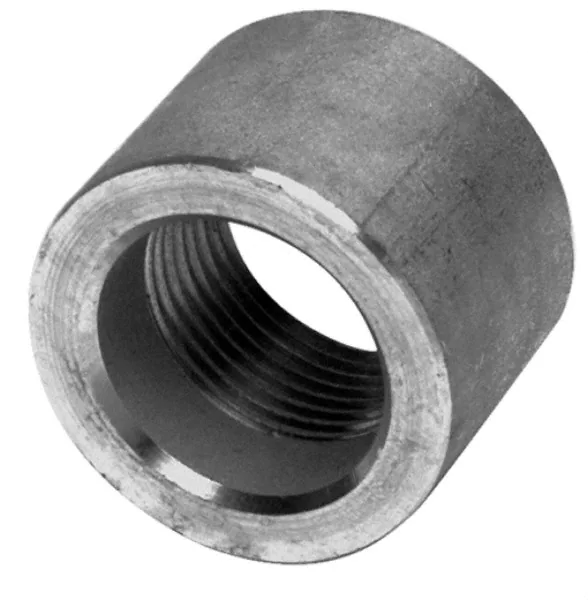
What are the Differences Between Half Couplings and Full Couplings in Pipe Fittings?
In pipe fittings, both half couplings and full couplings serve the purpose of joining two pipes together, but they differ in their design and applications. Here are the key differences between half couplings and full couplings:
- Design: The main difference lies in their design. A half coupling has one end with internal threads or a socket, allowing it to be connected to a threaded pipe or inserted into the end of a pipe without threading. The other end of the half coupling is an open end, ready to be welded or threaded to another pipe. On the other hand, a full coupling has both ends with female threads, enabling it to connect two threaded pipes directly without the need for welding.
- Function: Half couplings are commonly used to create a joint between a pipe and a component such as a valve, pump, or pressure gauge. The open end of the half coupling facilitates easy attachment to the component, while the threaded or socketed end connects to the pipe. On the other hand, full couplings are used when a direct, rigid connection between two pipes is needed, providing a continuous flow path without any interruptions.
- Application: Half couplings are frequently used in situations where frequent disassembly or maintenance may be required. For example, in systems with valves that need periodic inspection or replacement, a half coupling allows for easy removal without disturbing the entire pipeline. Full couplings, on the other hand, are more suitable for applications where a permanent, leak-proof connection is needed, such as in pressurized systems or critical process pipelines.
- Length: Full couplings are typically longer than half couplings because they need to accommodate two threaded ends, while half couplings have one threaded or socketed end and an open end, making them shorter in length.
- Installation: The installation process differs for half and full couplings. Half couplings are welded or threaded onto one pipe end and then connected to another pipe or component using welding or threading, respectively. Full couplings, on the other hand, directly join two pipes with threaded ends, requiring no additional welding or threading.
- Flexibility: Half couplings offer more flexibility due to their ability to connect to different types of components or pipes with varying end connections. Full couplings are less flexible in this regard, as they can only join two threaded pipes together.
Overall, the choice between half couplings and full couplings depends on the specific requirements of the piping system, including the need for temporary connections, the type of components being attached, the nature of the fluid being transported, and the desired level of joint permanence and flexibility.
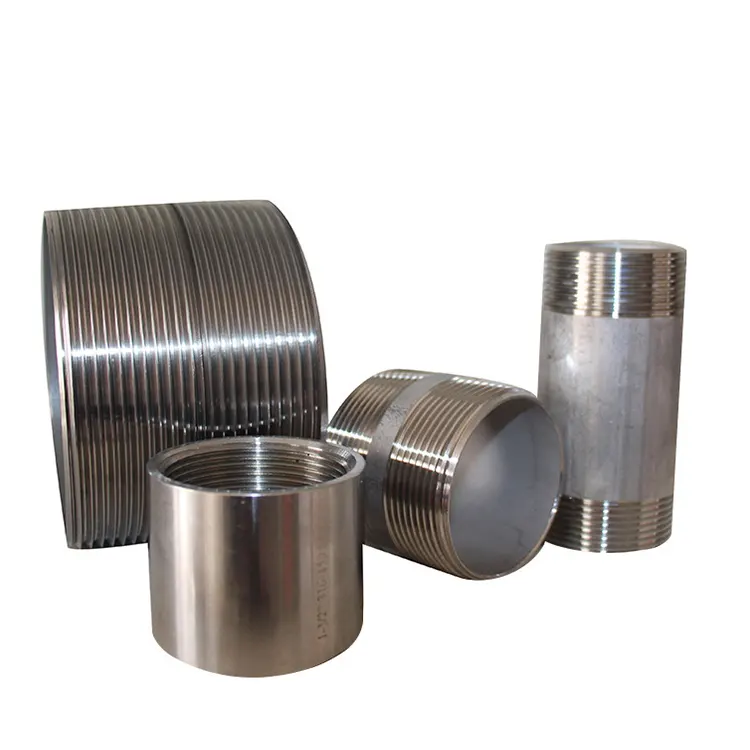
Can a Half Coupling be Used to Join Pipes of Different Diameters?
Yes, a half coupling can be used to join pipes of different diameters in piping and plumbing systems. Half couplings are specifically designed to connect two pipes of different sizes, making them ideal for creating transitions or connections between pipes with varying diameters. The larger end of the half coupling is welded or screwed onto the larger diameter pipe, providing a stable base for the connection. The smaller pipe, which has a different diameter, is then threaded or inserted into the smaller end of the half coupling.
The ability to join pipes of different diameters is one of the main advantages of using half couplings. This feature allows for efficient and smooth transitions between pipe sizes, which is crucial in maintaining proper fluid flow, reducing pressure losses, and preventing turbulence within the system.
Here are some common scenarios where half couplings are used to join pipes of different diameters:
- Reducing Pipe Size: When a pipeline needs to change from a larger diameter to a smaller diameter, a half coupling can be employed to create a smooth transition. For example, if a process requires a reduction in flow rate, a smaller pipe can be connected to the main pipeline using a half coupling.
- Connecting Equipment or Valves: In many industrial applications, equipment, valves, or instruments are connected to the main pipeline using half couplings. Often, these components have different pipe sizes than the main pipeline, and a half coupling provides a secure and leak-proof joint.
- Repair and Maintenance: During repair or maintenance operations, a damaged section of the pipeline can be cut out, and a new pipe of a different diameter can be connected using a half coupling. This allows for quick repairs without having to replace the entire pipeline.
When using a half coupling to join pipes of different diameters, it is essential to ensure that the threads and dimensions of the coupling match the pipes being connected. Proper sealing techniques, such as using thread sealant or Teflon tape, should also be applied to prevent leaks and ensure a reliable connection.
In conclusion, half couplings are versatile pipe fittings that enable the joining of pipes with different diameters. Their ability to facilitate smooth transitions and secure connections makes them invaluable in various industrial, commercial, and residential applications.


editor by CX 2024-01-12