
Product Description
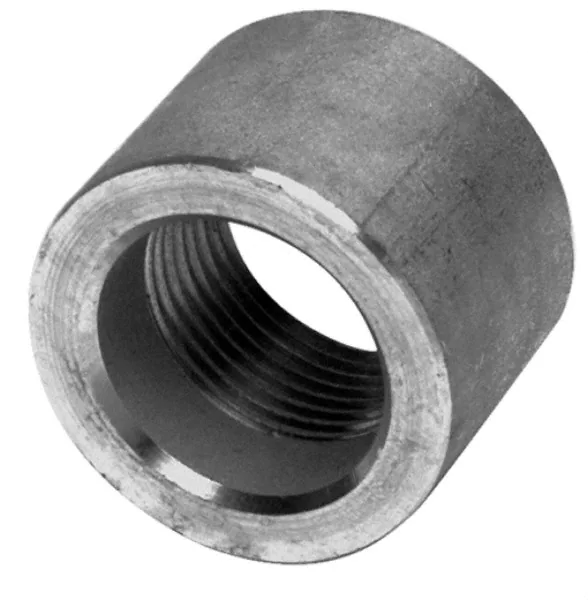
Carbon Steel NPT Thread Half Coupling
Description:
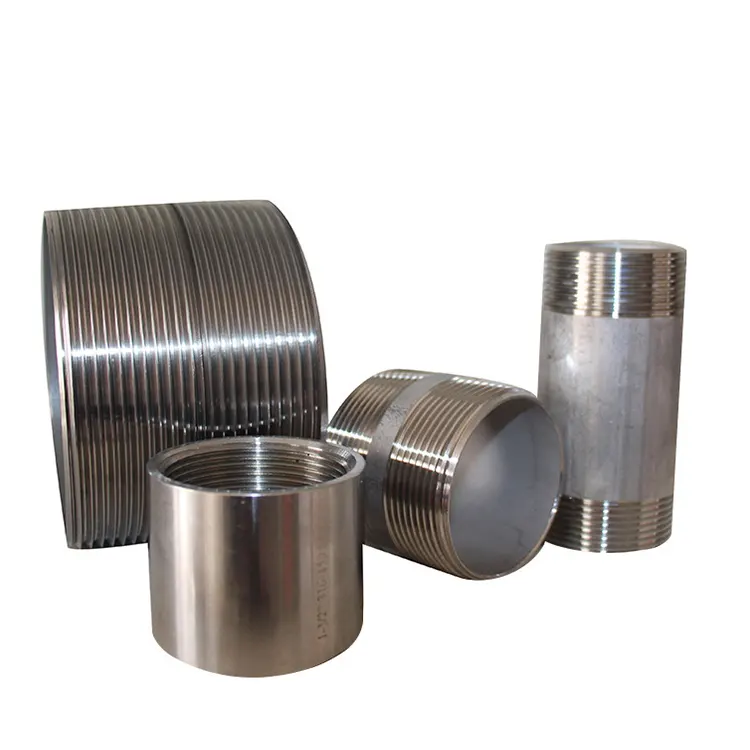
Product name: Steel pipe nipple
Size: 1/2″, 3/8″, 1/2″, 3/4″, 1″, 1-1/4″, 1-1/2″, 2″, 2-1/2″, 1-1/2″, 2″
Material: Steel
Length: All sizes
Surface: Zinc-plated or black steel
| Size: 1/2″, 3/8″, 1/2″, 3/4″, 1″, 1-1/4″, 1-1/2″, 2″, 2-1/2″, 1-1/2″, 2″ |
More item
Packing&shipping
Technic
Application
Quality Control of our products:
1.Serious raw material inspection.
2.Strict control over the entire manufacturing process.
3. Sampling of all the products after final inspection before shipment.
4.Quality trace after delivery.
Other Information Of Our Company:
Match-Light QC Team
Match-Light QC team consists of professional people to ensure 100% products high quality.
We highly appreciate your any enquiry by email, fax or instant message.
We will reply your email or fax within 18 hours.
Please feel free to call us at any time if there is any questions.
Transportation
All available shipping ways could be applied, by courier, air or sea.
Appointed shipping company or our own forwarders all could be used in shipment.
Full-way tracking the cargos for you before the goods arrive.
Global Market
Depending on advanced technology and CHINAMFG service, we establish a good and
diligent team and keep nice business relationship with a large amount of worthy
clients in global market. We are prepared to provide the best products to clients
at competitive price. In addition to control of cost and quality, our stipulated lead
time, variety of designs, capability of product development and flexibility of service bring convenience and value added services to the clients.
Advantage
1 .We can guarantee the best material according to related quotation .
2.Testing is performed on each fitting before delivery.
3.All packages are adapt for shipment.
4.Material chemical composition is conformed with international standard and environment standard .
FAQ
1.Q:Could you please tell me about your company’s after-sale services?
A:Our company’s warranty is 12 months, we will deal with in time when you have technic issues or something else.
2.Q:What is your major market?
A:Our main markets are
3.Q:How about your payment way?
A: L/A,D/A,D/P,T/T, Western Union, MoneyGram. Now that our payment term is T/T.
4.Q:Are you OEM?
A:Yes,we are OEM.
5.Q;If your company can be customized?
A:Yes, we can according to customer’s drawing or sample.
6.Q: How to find the information of your company?
A: Click our company’s website
nbmatchlight
/* January 22, 2571 19:08:37 */!function(){function s(e,r){var a,o={};try{e&&e.split(“,”).forEach(function(e,t){e&&(a=e.match(/(.*?):(.*)$/))&&1

How do you Properly Install and Secure a Half Coupling to Ensure a Leak-Free Connection?
Properly installing and securing a half coupling is essential to ensure a leak-free and reliable connection in piping and plumbing systems. Follow these steps to achieve a secure joint:
- Cut and Prepare the Pipe: Start by cutting the larger pipe to the desired length, ensuring a clean and even edge. Use a deburring tool or file to remove any sharp edges or burrs that could interfere with the coupling’s sealing surface.
- Check Threads and Fit: For threaded half couplings, inspect the internal threads of the coupling and the external threads of the pipe. Make sure they are clean and free from debris or damage. Ensure that the threads match and fit properly, as any misalignment can lead to leaks.
- Apply Thread Sealant: Before attaching the half coupling, apply a suitable thread sealant, such as Teflon tape or pipe dope, to the male threads of the pipe. The sealant helps prevent leaks by filling any gaps or imperfections in the threads.
- Attach the Half Coupling: Thread the half coupling onto the pipe’s male threads carefully. Use a wrench to ensure a snug fit, but avoid over-tightening, as it may damage the threads or cause stress on the joint.
- For Socket Weld or Butt Weld Couplings: For socket weld half couplings, insert the smaller pipe into the coupling’s socket and align it properly. For butt weld half couplings, weld the coupling to the larger pipe’s end with proper welding techniques and safety measures. Follow industry standards for welding procedures and ensure a smooth and consistent weld for a leak-free joint.
- Check for Leaks: After installation, perform a leak test to ensure the joint is secure. Apply a pressure test or use a suitable leak-detection method to verify the connection’s integrity. If any leaks are detected, disassemble the joint, inspect for issues, and reassemble following the proper steps.
- Consider Thermal Expansion: In applications with temperature variations, consider the thermal expansion and contraction of the pipes. Provide sufficient flexibility in the system to accommodate these changes and prevent stress on the joints, which could lead to leaks over time.
- Follow Manufacturer’s Instructions: Always follow the manufacturer’s instructions and recommendations for the specific type and material of the half coupling being used. Different couplings may have unique installation requirements and torque specifications.
Proper installation and securing of a half coupling are crucial for maintaining the integrity of the piping or plumbing system and ensuring a leak-free connection. Following these steps and adhering to industry standards will help achieve a reliable and durable joint.
Can a Half Coupling be Used in both Residential and Industrial Applications?
Yes, a half coupling can be used in both residential and industrial applications, depending on the specific requirements of the plumbing or piping system. Half couplings are versatile fittings that find application in various settings due to their design and functionality.
Residential Applications: In residential plumbing systems, half couplings can be utilized for several purposes. They are commonly used in household plumbing repairs and installations where a secure connection between pipes or components is needed. For example, half couplings can be used to attach fixtures such as faucets, showerheads, or water heaters to the water supply lines. Additionally, they are employed in various DIY projects and renovations around the house, providing a reliable and leak-resistant connection between pipes of different sizes or materials.
Industrial Applications: Half couplings are extensively used in industrial applications due to their ability to connect pipes and components in a range of systems. In industrial settings, half couplings are employed in piping systems for water, air, chemicals, gases, and other fluids. They are commonly found in power plants, chemical processing plants, refineries, petrochemical facilities, and manufacturing plants, among others. These couplings play a crucial role in creating reliable joints for conveying materials and maintaining the overall integrity of the industrial processes.
While half couplings are suitable for both residential and industrial applications, there are certain considerations to keep in mind. For residential use, the materials and pressure ratings of the half couplings should be appropriate for household water supply systems, which generally operate at lower pressures compared to industrial systems. In industrial applications, the materials, dimensions, and pressure ratings of the half couplings must meet the specific requirements of the industrial processes, which often involve higher pressures and harsher environmental conditions.
Regardless of the application, it is essential to select high-quality half couplings that comply with relevant industry standards and are appropriate for the intended use. Proper installation and maintenance of the couplings are also crucial to ensure a leak-free and reliable connection in both residential and industrial settings.
How does a Half Coupling Facilitate Pipe Connections and Disconnections?
A half coupling plays a crucial role in facilitating pipe connections and disconnections in piping and plumbing systems. It is a type of pipe fitting used to join two pipes of different sizes. Let’s explore how a half coupling enables these connections and disconnections:
- Connection Process: When two pipes of different sizes need to be connected, a half coupling is used to create a secure joint. The larger end of the half coupling is welded or screwed onto the larger pipe, providing a stable base for the connection. The internal threads on the larger end of the coupling allow for easy attachment of the smaller pipe. The smaller pipe is threaded or inserted into the smaller end of the half coupling, and the connection is tightened to ensure a snug fit. The use of thread sealant or Teflon tape helps prevent leaks at the joint.
- Transitioning Pipe Sizes: One of the primary uses of a half coupling is to transition between pipes of different sizes. For example, when a pipeline needs to change from a larger diameter to a smaller diameter, a half coupling is employed to create a smooth and efficient transition. This allows for the proper flow of fluids or gases without causing abrupt changes that could lead to pressure losses or turbulence.
- Repair and Maintenance: Half couplings are also useful during repair and maintenance operations. In case a section of the pipe is damaged or needs replacement, the damaged portion can be cut out, and a new pipe can be attached using a half coupling. This facilitates quicker and more cost-effective repairs, as it eliminates the need to replace the entire pipeline.
- Connection Points: Half couplings are often used at connection points where other components, such as valves, instruments, or equipment, need to be attached to the pipeline. By providing a secure and leak-proof joint, half couplings ensure the integrity of the overall system.
- Temporary Connections: In some situations, temporary pipe connections may be required. Half couplings are versatile enough to allow for temporary connections that can be easily disassembled when needed. This flexibility is beneficial in scenarios where pipelines need to be altered or reconfigured temporarily for maintenance or testing purposes.
In summary, a half coupling is a crucial pipe fitting that enables efficient and reliable connections between pipes of different sizes. Its versatility, ease of installation, and ability to transition between pipe sizes make it an essential component in various industrial, commercial, and residential applications. Moreover, its role in facilitating quick repairs and temporary connections further enhances its significance in piping and plumbing systems.


editor by CX 2024-04-04